
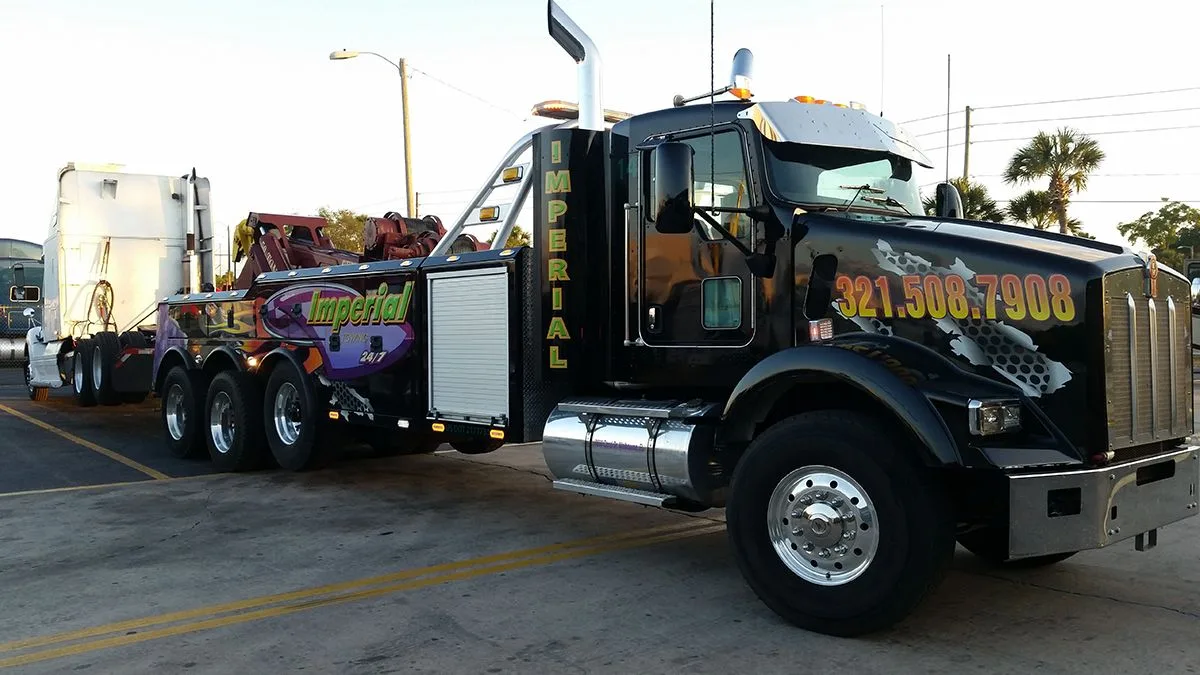
The Whole Rig Rides, Or Just The Tractor.
A stopped tractor-trailer on SR-429 or US-441 is two vehicles until somebody decides otherwise. We tow tractors still coupled to their trailers, tractors running bobtail, and the combinations that have to come apart first, anywhere around Apopka and northwest Orange County.
Rigs
Hooked To A Trailer, Or Running Alone?
The first thing dispatch wants to know about a stopped tractor-trailer is whether it is still one unit. A tractor running bobtail is a heavy truck with a short wheelbase and an empty fifth wheel on the back. Couple that same tractor to a loaded box trailer and the combination weighs several times as much, with trailer brakes and lights that depend on air and power from the cab.
That answer changes the wrecker we send out of Melbourne. A bobtail can usually be lifted and towed by a heavy wrecker sized to the tractor alone. A coupled rig needs a unit rated for the full combination, plus a plan for the trailer brakes, the lights and whatever is inside the box. Sending a lighter truck to a loaded rig is how one tow turns into two calls and a longer lane closure.
So the questions come in a set order. What weight class is the tractor, and is the trailer loaded or empty? Is the rig on the shoulder or sitting in a travel lane? Which road, and roughly where on it: SR-429, SR-414, US-441, or a lot just off one of them? Answer those and the crew leaves the yard with the right equipment already chained on, rather than sorting it out beside moving traffic.
Brakes Caged, Or Air Hooked Up.
Big trucks park on spring brakes. When a tractor loses air, from a ruptured line, a dead compressor or an engine that will not run, those springs clamp the brakes on and the wheels stop turning. On the highway that is a safety feature. For anyone trying to move the truck it is the first problem, and it gets solved before the rig rolls an inch.
Our operator picks one of two ways through it on the scene:
- Supply air from the wrecker. Our unit connects to the truck through its glad hands, builds pressure and releases the brakes the normal way, which also keeps the trailer brakes working behind the tow.
- Cage the spring brakes. When the air system is too damaged to hold pressure, the springs get backed off mechanically at each chamber so the wheels turn free. That truck then stops on the wrecker alone, so the tow runs slower and is planned around it.
The driveline gets attention at the same time. Towing a tractor on its drive wheels with the driveshaft connected spins a transmission that is not being lubricated. On most tows the driveshaft comes off or the axle shafts get pulled before we leave, and those parts ride along with the truck.
Which Axle Comes Off The Ground.
Heavy wreckers tow with an underlift, a boom that reaches under the truck and raises one end of it. On a tractor that usually means picking up the steer axle and letting the drive axles roll, which is why the driveline work above matters. Sometimes it runs the other way. A crushed front end, a broken steering part or a tractor nosed into soft ground can mean lifting from the rear and towing it backward.
With a trailer still coupled, the lift carries part of the combination on top of the tractor itself. Our operators check what the front axle can take, how the freight sits in the trailer and how much weight transfers onto the wrecker once the nose comes up. An overloaded front axle steers poorly and brakes worse, and on a road like US-441 that is a gamble nobody should take.
Twenty-eight years of this work comes down to small checks done every single time. Our drivers are certified, online and hands-on, and they run the same sequence whether the tractor is a day cab or a sleeper.
When The Trailer Has To Stay Behind.
Some rigs cannot travel coupled. The trailer may be too heavy for the tow, its landing gear or suspension may be damaged, or the freight may need to go somewhere other than the tractor. In those cases the trailer gets dropped, either where it sits if the scene allows it or after a short move somewhere safer, and the tractor is towed on its own.
Dropping a loaded trailer on a shoulder is a decision the carrier makes with us, never one we make alone. Most carriers want a replacement tractor to come and hook it so the load keeps moving toward its delivery. Dispatch will ask early whether one is coming and roughly when, because a power swap timed well keeps the trailer off the roadside for the shortest possible stretch.
If the trailer is the broken part, the options change. It can be towed by itself behind a heavy wrecker, or the freight can be moved to another trailer first. Tell us what is aboard and who owns it, and we will lay out what works before anyone touches the kingpin.
The Address Matters As Much As The Hitch.
A disabled tractor-trailer usually has one of three destinations. The carrier’s own terminal, if one is within reach. A repair shop the fleet already trusts, whether that is down the road or across the state. Or our yard, where the unit can sit while the owner and an insurer decide what happens next.

Long hauls are normal for us, so a shop on the far side of Florida is fine as long as we hear about it on the first call. If a closer shop makes more sense for the repair, dispatch will say so and you make the call. Apopka is roughly 85 miles from our Melbourne yard, and we say that up front along with a real window for your exact spot.
More about the service itself is on our tractor-trailer towing page. If your rig is stopped and safe, send dispatch the details and we will plan the tow with you.
More Big-Rig Work Near Apopka
Construction Equipment Transport
Excavators and dozers moved on lowboys.
See the details →Accident Scene Cleanup
Glass, parts and fluids off the lanes.
See the details →Machinery Moving
Single machines trailered and tied down.
See the details →Fleet Roadside Assistance
Commercial units kept on their routes.
See the details →Apopka Heavy Work
Every heavy job we run in Apopka.
See the details →Orange County
Big-rig recovery across the county.
See the details →Before The Rig Leaves The Shoulder.
Can you tow a tractor with the trailer still attached?
What happens if the truck has no air?
Do you pull the driveshaft before towing a semi?
Can you leave the loaded trailer for our own tractor to pick up?
Where can you take the tractor?
How long does it take you to reach Apopka?
Most tractor-trailer calls from Apopka start on the expressways or in a lot just off them. When you phone, have the weight class, the load status and the exact spot ready, and tell us if a replacement tractor or a second trailer is already headed out. That is enough for dispatch to send the right unit the first time.
Rig Stopped Near Apopka? Give Us Three Answers.
Loaded or empty, coupled or bobtail, lane or shoulder. With those, dispatch picks the wrecker, tells you how long the run from Melbourne takes and gives you a straight, no-surprise price on your tow before anyone rolls. The rest of our heavy work here is on the Apopka page, or write to dispatch online and we will call you back.
Our heavy wreckers on real jobs are in the gallery.