

Keep The Unit On Its Route.
Tires, jump starts, lockouts and fuel brought to commercial trucks stopped on the shoulder near Apopka and across northwest Orange County, dispatched on your fleet account with the unit details already on file. When the problem cannot be fixed where the truck sits, the same call becomes a heavy tow. Imperial Towing runs it out of Melbourne, 28 years in.
Fleet
What Gets Fixed On The Shoulder.
Fleet roadside assistance exists to keep a commercial truck working. A flat on a box truck, a tractor that will not turn over after a long stop, a driver locked out of the cab at a fuel island, a unit that ran dry short of the next station. None of those needs a tow when the rest of the truck is sound, and every hour it sits is a delivery that slides.
For fleets, our roadside work comes down to four calls, each one handled for commercial units:
- Tires on the shoulder when a spare or replacement is on hand and the wheel itself is undamaged.
- Jump starts for heavy batteries that drained overnight or after a long idle.
- Lockouts for cabs and sleepers when the keys are on the wrong side of the door.
- Fuel delivery to a truck stopped short, so it can reach a station.
The full scope sits on our fleet roadside assistance service page. Around Apopka, every one of these calls runs with the same certified drivers we send for recovery work, because a unit that will not respond to roadside help is already halfway to being a tow.
One Number For The Whole Fleet.
A fleet account puts your trucks on file before anything goes wrong. When a driver or your office calls, the call goes straight to our dispatch, and the person answering already has the details that would otherwise get collected over a bad connection on a loud shoulder.
An account file usually holds unit numbers with make, model and weight class for each truck, plus your preferred shops or terminals by region, so a tow has a destination before it starts. It also names who can approve a tow when roadside help will not get the truck moving, and the billing contact, which keeps account details off the driver’s plate entirely.
Pricing is settled ahead of time, so nobody on the shoulder negotiates while a truck waits. One number covers your whole fleet statewide, which matters for carriers whose routes run through northwest Orange one day and the far side of Florida the next. Setting an account up starts with a short note to dispatch.
When A Roadside Call Turns Into A Tow.
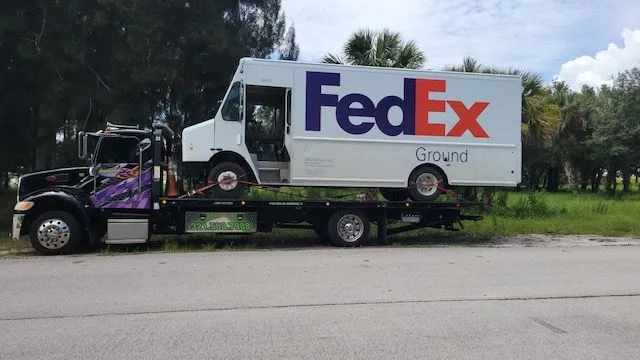
Some trouble cannot be fixed on the shoulder, and pretending otherwise just loses the afternoon. A truck that loses air, drops a driveshaft, cracks a wheel or will not run after a jump has to go somewhere with a bay and a lift. So does any unit sitting where working beside it would put a person at risk.
When that happens, the account already says where the truck goes: your shop, your carrier terminal or our yard. If your preferred shop is in another part of the state, we can take it there. If a closer one makes more sense for this repair, dispatch will say so, and you decide.
Tractors go behind heavy wreckers sized for the weight and the air brakes, the work covered on our Apopka tractor-trailer towing page. Step vans and smaller commercial trucks can ride a rollback strapped down to the deck.
Answers The Driver Should Have Ready
A good call is short and saves a wasted trip. Before your driver dials, these are the answers dispatch will ask for:
- Unit number, so the truck on file matches the truck on the shoulder.
- Location, with the road, the direction of travel and the nearest exit or mile marker on SR-429, SR-414 or US-441.
- The load, loaded or empty, and what is aboard.
- The problem in plain words, plus whatever the driver has already tried.
- How the truck sits: a wide shoulder, a ramp, a lot or partly in a lane.
A phone photo of the dash warning lights or the damaged tire, sent when dispatch asks for one, often settles the roadside or tow question before anything leaves the yard. A driver new to your account needs no special briefing to make the call, only the unit number and a clear look at where the truck is sitting.
Those answers decide whether we send a roadside truck or a wrecker on the first trip. If the unit is in a live lane or anyone is hurt, the driver calls 911 first and gets clear of the truck. We handle the part that comes after.
Planned From Melbourne, Timed For Your Route.
Our yard is in Melbourne, roughly 85 miles from Apopka, and we tell fleet managers that before they sign anything. A roadside call here is planned around real drive time, so dispatch gives you a window for the exact spot rather than a number that sounds good on the phone.
That honesty shapes how fleets use us. A truck parked safely at a lot or on a wide shoulder, waiting on a tire or a few gallons of fuel, is exactly the job we run well. A truck in a dangerous spot needs the nearest available help first, and we pick up the work once the situation is calm.
The same account also covers our fleet towing service, so one dispatch handles everything from a dead battery to a full tow. Questions about how it fits your routes? Call (321) 499-4610.
The Rest Of Our Apopka Lineup
Tractor-Trailer Towing
Tractors hooked with or without the trailer, air brakes handled before the tow.
View the service →Construction Equipment Transport
Excavators and dozers loaded on a lowboy for site to site moves.
View the service →Accident Scene Cleanup
Glass, debris and fluids dealt with after the vehicles are hooked.
View the service →Machinery Moving
Shop machines, generators and compressors hauled on a matched trailer.
View the service →Apopka
Our whole heavy lineup for the Apopka area.
View the service →Orange County
Recovery, towing and transport across Orange County.
View the service →What Fleet Managers Ask Before Signing On.
Which roadside services do you offer for fleet trucks?
How do we open a fleet account?
Should our drivers call you directly, or our dispatcher?
How soon can you reach a truck near Apopka?
What happens if the truck cannot be fixed roadside?
How is fleet roadside assistance priced?
Fleet roadside is one piece of the commercial work we run around Orange County. Recovery, heavy towing and equipment hauls go through the same dispatch, under the same account. If your fleet mixes box trucks, tractors and equipment trailers, put every one of them on file so the right truck leaves our yard on the first trip.
Trucks Running Northwest Orange? Put Them On File.
Send your unit list, your preferred shops and the people who can approve work. We settle the pricing up front, load the details into dispatch and give your drivers one number to call from the shoulder. Every other job we run here is listed on the Apopka page. To get going, start the account and we will call you back.
Browse our heavy units on real jobs in the photo gallery.