
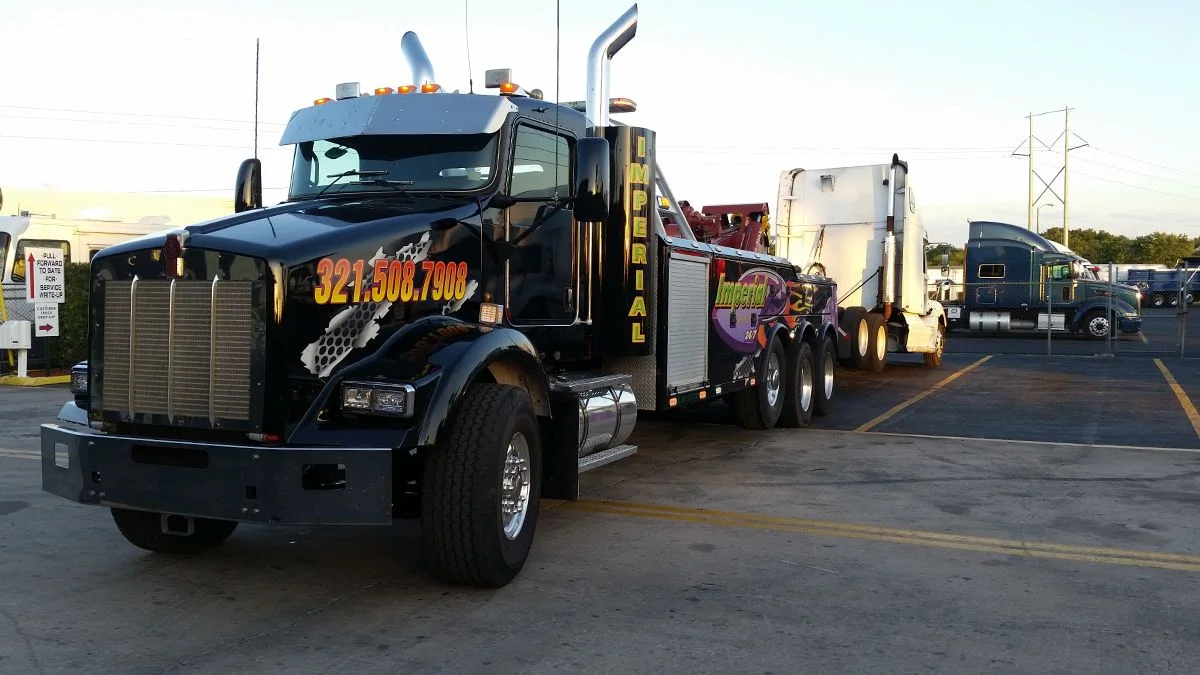
The Rig Quit On I-4. Now It Rides Behind Ours.
Tractors, trailers and full combinations towed out of Orlando and Orange County on heavy wreckers rated for the weight, with the air system handled before a single wheel turns.
Freight
Bobtail Or Loaded Is The First Question.
Two calls can sound identical on the phone and turn out to be completely different jobs. A bobtail tractor, nothing hooked behind it, is a heavy tow that a properly rated wrecker handles with an underlift and some care around the fifth wheel. Put a loaded trailer behind that same tractor and the problem changes shape. Now there is cargo weight, a trailer that may or may not have working brakes of its own, and a decision about whether the combination travels together or comes apart first.
That is why our dispatcher starts with plain questions. Is the trailer still coupled? Loaded or empty? What is inside it, roughly? Does the tractor still build air? Those answers pick the truck, the rigging and sometimes a second unit, and they get settled before anybody leaves the Melbourne yard. A driver who has the gross weight off the bill of lading saves everybody time. A driver who does not is still fine, because we will work it out together on the call. Guessing at this stage is how one tow quietly turns into two.
Before The Hook: Brakes And The Driveline
A tractor-trailer stops for good when its spring brakes clamp on after air pressure drops. That is a safety feature, and it is also the reason a dead rig cannot simply be pulled away. Before the tow, our operator either supplies air from the wrecker to release those brakes or cages them, winding the release bolts in so the shoes stay off for the trip. Skip that step and you drag locked wheels down the pavement, flat-spotting tires and cooking brake parts that were perfectly good an hour earlier.
The driveshaft is the other half. Tow a tractor on its front axle with the drive wheels rolling and the transmission spins without the lubrication it gets when the engine runs. So the driveshaft comes out, or the axle shafts get pulled, and the parts ride along bagged and labeled for the shop. It takes a few minutes on the shoulder and spares you a transmission repair that would make the tow look small.
Neither step gets rushed because traffic is close. The wrecker is parked first, angled so the work happens behind it, and only then does anyone crawl underneath.
A Wrecker Matched To The Tractor.

A sleeper tractor on its own outweighs most tow trucks on the road. Hang its front axle on an underlift and the wrecker carries a big share of that weight on its own rear axles, while it still has to steer and stop with traffic moving around it. That takes a heavy wrecker whose boom, underlift rating and axle count match the tractor, and it is the only kind of truck we send to a semi call. Our semi-truck towing runs on that rule everywhere in Florida, Orlando included.
Length is the other match. A day cab and a long-wheelbase sleeper hang very differently off the back of a wrecker, and the combined length has to clear every merge and turn between the shoulder and the drop. Expressway ramps on the 408 and the streets around the convention district ask different things of a long combination, so the route gets planned around the full length on the road. Dispatch asks for the make, and whether it is a day cab or a sleeper, for exactly this reason.
Where The Truck Ends Up
Half the decisions on a semi tow have nothing to do with the hook. Where is the tractor going? A dealer that works on that make, your company terminal, your own lot, or a yard where it waits for an adjuster. Each one changes the route, the timing and who needs to be expecting it. A shop that has closed for the evening will not take a tractor at the gate, and a terminal may need a name on a list before our driver can pull in.
We sort that out before the wheels turn. If the answer is still open when you call, say so, and we will hold the move until you have it instead of hauling the rig somewhere and then hauling it again. Settling the destination first is also how one invoice stays one invoice. Owner-operators feel the difference most: the truck goes once, to the right place, and the paperwork matches the trip it actually made.
Seventy-One Miles, Said Out Loud.
Our yard is in Melbourne. Orlando is about 71 miles from it, and you should hear that number from us now instead of discovering it on a shoulder. If your rig is stopped in a live lane, or anyone is hurt, call 911 and let the nearest wrecker make the first move. Imperial is the call once the truck is off the road and secured, at a truck stop, in a lot or on a wide shoulder behind the trooper’s cones, and it needs to go somewhere specific with a crew that does this every week.
For that kind of call the distance is routine. Dispatch gives you a real window for your location, said plainly, and the wrecker we send is the one that finishes the job.
- Air handled first: spring brakes released or caged before the rig moves an inch.
- Driveline out: driveshaft or axle shafts pulled, bagged and riding with the truck.
- Wrecker sized to the tractor: boom, underlift and axles rated for what hangs on the hook.
- Drop settled early: dealer, terminal or your own lot, decided on the first call.
- 28 years of heavy work: certified drivers, trained online and hands-on.
Save the number before you need it. Send us your fleet details or ring (321) 499-4610 and we will have them on file.
More Help In Orlando
Rollover Recovery
Rigged, righted, made safe, then moved.
See the details →Excavator Transport
Tracked machines chained down on a lowboy.
See the details →Crane Transport
Crawler cranes hauled stowed, boom secured.
See the details →Fleet Towing
Account dispatch for carriers and utility fleets.
See the details →All Orlando Heavy Work
Everything heavy we run around Orlando.
See the details →Orange County
Heavy recovery across the I-4 and 408 network.
See the details →What Drivers And Dispatchers Ask Us.
Can you tow a loaded tractor-trailer out of Orlando?
Why does the driveshaft have to come out?
What does caging the brakes mean?
How far is your yard from Orlando?
What will a semi tow from Orlando cost?
Can you take the truck to our terminal instead of a shop?
A good share of the semi work we run out of Orlando is no emergency at all. A tractor that limped into a lot overnight, or a unit that has to reach a dealer in another city, is a planned tow, and planned tows are where a Melbourne crew earns its place in Orange County. Call ahead, give us the details, and the job goes on the board with the right wrecker already assigned.
Rig Parked On The Shoulder? Give Dispatch The Unit Number.
Add the axle count, loaded or empty, and where the truck is sitting. We will match a heavy wrecker to it, cage the brakes and pull the driveline on site, then haul it to the shop, terminal or lot you name. You will hear the distance from Melbourne honestly and get a straight, no-surprise price on your tow before anything rolls. Twenty-eight years of heavy work says the first truck should be the right one. The rest of what we run there is on the Orlando page, or write to dispatch and we will call you back.
Our wreckers and lowboys are in the photo gallery.