
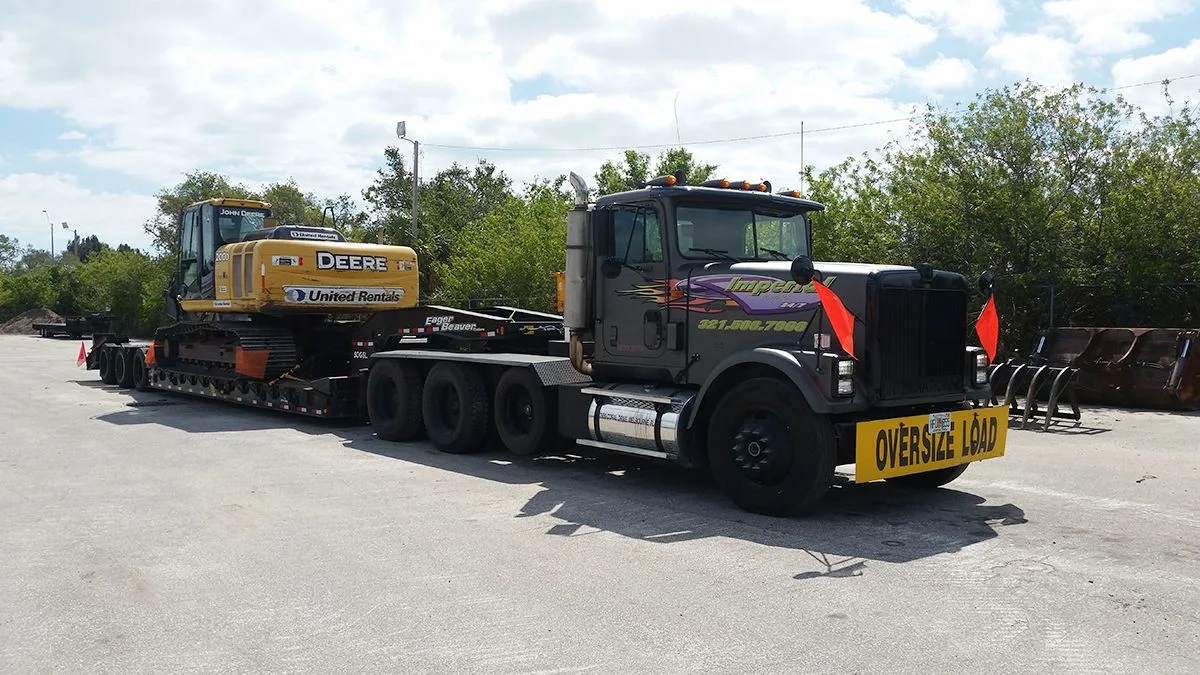
Tracks Off One Site, Down On The Next.
Tracked excavators moved between job sites across Orlando and Orange County on a lowboy, chained at every point, bannered when the load runs oversize and set down where the next crew wants it.
Lowboy
Booked Ahead, Priced Before We Roll.
Moving an excavator is planned work, and that suits the way we operate. We run out of a Melbourne yard roughly 71 miles southeast of Orlando, which makes us the wrong call for a machine somebody needed across town an hour ago and exactly the right one for a move you can put on the calendar. Most contractors know the day a machine has to leave one site and reach the next well before it arrives. Call us the moment you know it.
When you book, dispatch works through the machine, both addresses and anything unusual about either site, then quotes you a straight, no-surprise price on your tow. That quote comes before the truck moves, and it holds unless the job itself changes. You will know the plan for the day and who is driving. We have hauled heavy equipment across Florida for 28 years, and the contractors who keep booking us do it because the machine shows up as planned and nobody argues over the invoice afterward.
Why Tracks Only Ride A Lowboy
A tracked excavator has no business on a flatbed or a tilt deck built for wheeled equipment. Steel or rubber tracks need a deck that sits low and flat, ramps that hold the machine’s weight as it climbs, and enough length that the weight lands between the trailer’s axles instead of hanging off one end. That trailer is a lowboy, and for tracked and oversize loads it is the only one we use.
The low deck matters for more than loading. Dropping the machine closer to the pavement keeps the overall height down, which can decide whether a load clears a bridge or has to be routed around it. It also lowers the center of gravity through every turn and ramp between the two sites. Our excavator transport runs on lowboys sized to the machine. A compact unit and a full-size excavator rarely ride the same trailer, and dispatch picks the one that fits your weight and width before a truck is assigned.
Chain By Chain, Bucket To Counterweight.
Loading starts with the deck. Our driver checks that it is level and clear, sets the ramps, and talks the operator up slowly, tracks centered, boom pointed straight ahead. Once the machine sits in position it is lowered and the securing begins.

Tracked machines get chained at both ends, front and rear, with rated chain and binders pulling in opposite directions so the excavator cannot creep forward, back or sideways under braking. The boom and stick come down, the bucket is curled and rested on the deck, and then the bucket gets its own chain so it cannot swing or bounce over a rough patch. The upper structure is locked against rotation. Every binder is checked before the truck pulls out and again after the first few miles, because chain settles as the load does.
Attachments travel with the machine or beside it. A hydraulic hammer, a spare bucket or a set of forks gets its own tie-downs on the deck, never thrown in the cab or left loose behind the counterweight. Mention anything extra when you book, so the deck space and the chain count are planned for it before the truck is loaded.
The crawler crane above is tied down by the same logic, tracks pinned to the deck at both ends. That routine never changes between a short hop across Orange County and a run to the other end of the state.
Oversize Means The Route Gets Planned.
Plenty of excavators run wider or taller than a normal load once they sit on a trailer. When that happens the truck runs with an OVERSIZE LOAD banner and flags, like the rig at the top of this page, and the route stops being a matter of picking the shortest road. Overhead clearances and bridge ratings get checked against the actual loaded dimensions, and the run is planned around anything that does not fit, whether the next site is up near Apopka off SR-429 or closer in toward downtown and the 408. Help us plan it by having these ready when you call:
- The machine: make, model and operating weight, plus any attachment or thumb.
- Both addresses, with a site contact for each end.
- Gate hours, overhead wires or anything tight on the way in.
- The date it has to be off site and the date the next crew needs it.
Soft Dirt At Both Ends Of The Trip
Job sites are the hardest part of the haul. Ground that held a loaded dump truck all summer can turn to soup after a week of rain, and a lowboy is long, heavy and low enough to bottom out or bog down where a pickup drives straight through. Tell us honestly what the site looks like. If the approach is soft, we plan where the truck stops and how far the machine tracks to meet it, so a delivery never turns into a recovery with a buried trailer.
At the far end the goal is simple: set the machine down exactly where the next crew needs it. That might be beside the trench, inside a fenced pad or at the edge of a slab that cannot take the truck’s weight. Point to the spot and our driver works to put it there. Whatever the machine does under its own power once it comes off the deck is the operator’s call, and the trailer stays steady until it is clear. Rental machines often carry a return window set by the rental yard; give us that window and the run gets built around it.
Booking a move for later this month? Send us the job details and dispatch will call to confirm.
More Help In Orlando
Semi-Truck Towing
Disabled tractors towed with the air handled.
See the details →Rollover Recovery
Overturned rigs brought upright with care.
See the details →Crane Transport
Crawler cranes moved with the boom stowed.
See the details →Fleet Towing
Account terms for carriers and municipal fleets.
See the details →All Orlando Heavy Work
Heavy towing and hauling across the city.
See the details →Orange County
Lowboy and wrecker work across the county.
See the details →Before You Book The Lowboy.
How much notice do you need to move an excavator?
Can you move a mini excavator too?
What makes an excavator load oversize?
Will a lowboy fit on our job site?
Can you haul other tracked equipment the same way?
Can the excavator go somewhere outside Orange County?
Excavators make up most of the tracked work we haul around Orlando, though the same lowboy carries forklifts, containers and other machinery that has finished at one site and is wanted at the next. If the equipment came to the job on a trailer, it can leave on one. Tell us what it is and we will tell you which trailer fits it.
Next Site Waiting On The Machine? Get It On The Board.
Send us the make and weight, the two addresses and the dates. We will match a lowboy, plan the route around anything tight and settle a straight, no-surprise price on your tow with you before the truck leaves Melbourne. On the day, the machine gets chained bucket to counterweight, runs bannered if it is oversize and comes off exactly where your crew wants it. Twenty-eight years of heavy hauling across Florida stands behind every booking. The Orlando page lists the rest of our work there, or book the move online and we will confirm by phone.
See lowboy loads like this one in our photo gallery.