
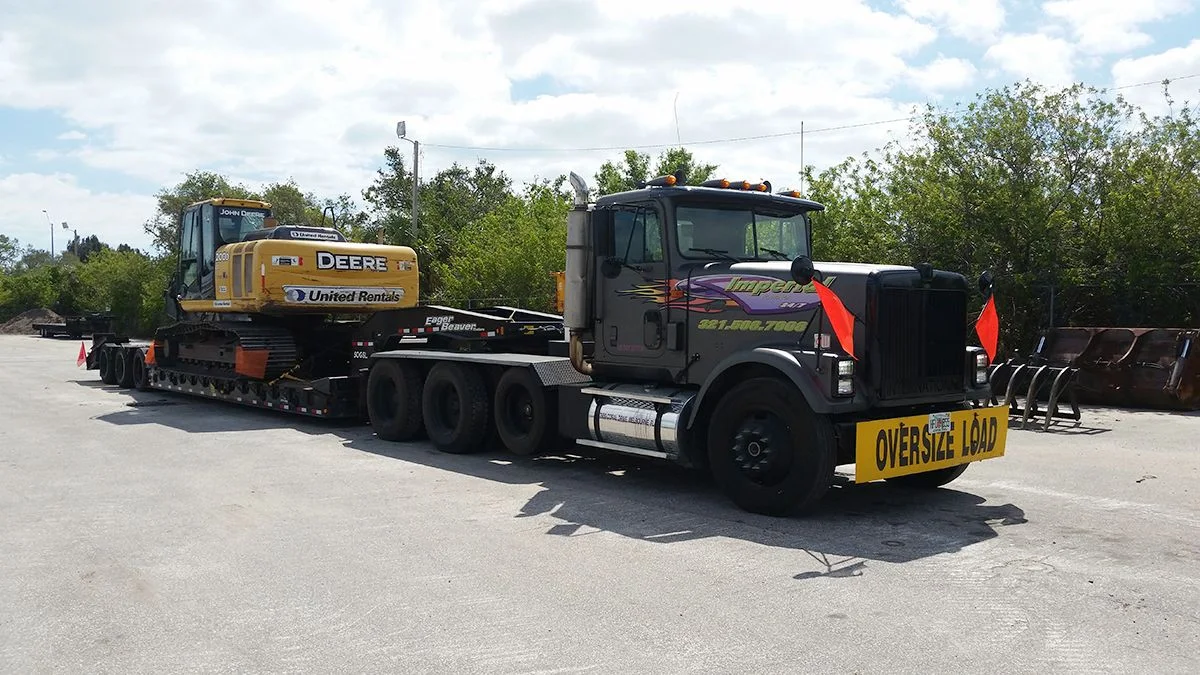
One machine, two job sites
An excavator that finished its work on one Orange County site and is wanted on the next does not drive there. A tracked machine moves on a lowboy, and the move goes smoothly when both ends get planned before the truck leaves Melbourne. That is about 71 miles of road before the job even starts, so this is scheduled work, quoted before anything rolls. Most of what makes an equipment move go right happens on the phone the day before. Below is what we ask, and why each answer matters to the people waiting at the far end.
Why a tracked machine rides a lowboy
Steel tracks and a tall deck do not get along. A lowboy drops its deck close to the ground, so a tall machine stays under bridge and wire clearances and the load sits low enough to stay stable through turns. The ramps are long and shallow, which lets an operator walk an excavator up without the machine pitching over the top.
Weight is the other reason. A mid-size excavator carries its mass in a small footprint, and the lowboy spreads it across enough axles to stay legal and keep the trailer tracking straight. A trailer chosen because it happened to be hooked up that morning is how a machine ends up hanging off the deck or overloading one axle group.
Tell dispatch the make and model, the operating weight if you have it, and whether the bucket, a thumb or a breaker is attached. Each of those changes the length, the height or the weight, and the trailer gets picked for the load during that call, long before anyone reaches the curb.
Loading at the first site
The pickup site needs a flat, firm spot long enough for the tractor, the lowboy and the ramps laid out behind it. If the machine is parked deep in a site full of trenches and rebar, somebody has to clear it a path to where the trailer can sit.
Your operator usually walks the machine up the ramps, or our driver does if no one from the crew is around. Either way, the boom gets curled in and the bucket set down on the deck before anything is chained. Then the chaining starts: binders at each corner of the tracks, the boom and bucket secured so they cannot swing, and a walk around to check every point before the truck moves. A loose chain on a tracked machine shows up the first time the rig brakes hard, which is exactly the wrong moment to find it.
Mud and loose dirt get knocked off the tracks before the trip, so they do not end up on the road behind the trailer.
The route between the two sites
An excavator on a lowboy is often tall or wide enough to need an OVERSIZE LOAD banner, flags and a route planned around it. Low bridges, overhead wires and tight turns all get checked before the truck leaves, because backing a lowboy out of a street it cannot clear is slow and risky for everyone.
Most runs from one Orange County site to another use the main roads, I-4 and the 408/417/429 network included, with the timing picked to keep a slow, wide load out of the worst traffic where we can. Any permits the load needs are handled ahead of the move date, never left for that morning.
If your site has a gate code, a security check-in or a set window for deliveries, tell us when you book. A lowboy idling at a locked gate is a lowboy blocking the road, and the drivers stuck behind it will not be patient about it.

Ground that gives after rain
A job site that was firm and dusty on Monday can be soup by Friday after a week of rain. A loaded lowboy is heavy, and its tires sink fast into soft ground. If the truck bogs down halfway into a site, the move turns into a recovery before the machine is even unloaded.
Tell us honestly what the ground looks like at both ends. Is there a paved or gravel pad near the gate? Has it rained hard in the last few days? Can the drop spot be reached without crossing open dirt? Sometimes the answer is to unload at the edge of the site and let your operator track the machine the rest of the way in.
That last option only works if the machine can travel the distance under its own power and the crew is fine with tracks crossing the site. Ask the superintendent before move day.
Mats or a short gravel path laid in advance can save a lot of time. A photo of the access road sent the day before saves even more, because it lets us plan the approach instead of discovering it with a loaded trailer.
Setting it down where the next crew needs it
The move is only done when the machine sits where the next crew can start work. That means knowing the drop spot exactly, and someone at the second site who can point to it. A vague spot near the trailer turns into a machine parked in the way of the concrete trucks arriving first thing.
Agree on the unload point, the approach the truck will use and who will be there to sign. If the crew needs the machine before a certain hour, say so when you book, and the run gets planned around it. Distance from our yard is the reason this work gets scheduled, and a set time makes the whole crew’s morning easier.
Price is settled the same way: a straight, no-surprise price on your tow, agreed before the truck moves. Our excavator transport in Orlando covers the lowboys in more detail, and crawler cranes follow a similar plan on crane transport.
Excavator move questions
Does my operator need to be there for loading?
It helps, though it is not required. Many crews like their own operator to walk the machine onto the lowboy because they know its controls and habits. If nobody from the crew can be there, our driver can load it. Either way, tell dispatch ahead of time who will run the machine, so the truck arrives with the right plan and nobody stands around waiting.
Can you move the excavator with the bucket attached?
Usually, yes. The bucket gets curled in and set on the deck, then chained so it cannot swing. A larger attachment, such as a breaker or a long reach arm, may change the height, length or weight enough to affect the trailer and the route. Mention any attachment when you book, and it gets planned into the move from the start.
How far ahead should an excavator move be booked?
As early as the job schedule allows. The trucks leave from Melbourne, a run of roughly 71 miles to Orlando, and an equipment haul is planned work. Booking ahead leaves time to check the route, sort any permits the load needs and line the drop up with the crew waiting at the second site. A quick phone call is the right place to start.
Two sites, one machine, one call
Have a machine to move? Call (321) 499-4610 with the model, both addresses and the date you need it there. The Orlando service area page lists the rest of the heavy work we run in the area, and you can send us the job details if typing it out is easier.