

The worst time to set up towing
A carrier’s first call to a tow company usually happens at the worst moment: a unit dead on I-4, a load due somewhere, a driver on the phone asking what to do. Every question about billing, authorization and destination gets answered then, under pressure. Fleets running Orange County do better settling those answers ahead of time. An account with us means one number for the whole fleet, statewide, and terms already agreed before anything breaks. Here is what goes into setting one up, and what to have ready when a unit goes down.
What an account settles ahead of time
Most of what slows down a fleet tow has nothing to do with the truck. Who can authorize the tow? How does billing work? Does the driver need a purchase order number? Which shop does this unit type go to? When those answers live in an account, the call turns into dispatch right away.
We sit down with the fleet manager once and work through it. Contacts for daytime and after hours, the people allowed to approve work, the billing setup and how invoices should be labeled. Terms get settled up front, so nobody negotiates on a shoulder. We do not publish rates. They get agreed as part of the account, with nothing to argue about later.
The same account covers every unit. A sleeper that dies near Orlando, a utility truck in Brevard, a day cab somewhere farther across the state: one number, and a dispatcher who already knows how your fleet runs and where its trucks belong.
Who calls, and what they should have ready
Whether a driver or a dispatcher makes the call, the same handful of details makes the job go right. Unit number first, so we can tie it to the account. Then the make and type, sleeper or day cab, axle count, loaded or empty, and exactly where the unit is sitting.
Location needs more than a highway name. I-4 and the 408/417/429 network carry a lot of road, so give the direction, the nearest exit or mile marker and anything nearby that stands out. A driver who can drop a pin from a phone saves a lot of back and forth.
Then say where the unit should end up. If your account lists a default shop or terminal for that type of truck, we already know. If it is different this time, say so on the call. Print this list and keep it in every cab, because a driver on a shoulder at night should not have to remember it.
One drop, one invoice
Half the value of a fleet tow is getting the unit to the right place the first time. A tractor dropped at the wrong shop has to be hooked and moved again, and that second move is a second charge nobody planned for. Settling the destination before anything gets hooked keeps the whole job on one bill.
It also keeps your accounting people sane. One tow, one destination and one unit number on the paperwork means the invoice matches the repair order without anyone calling around to figure out where the truck went.
For most fleets, the answer is your own shop or terminal. Your mechanics know the trucks, your yard has the room, and the unit sits inside a fence you control. Some carriers use a dealer for warranty work and their own shop for everything else, and the account can carry both rules.
If a loaded trailer needs to go somewhere other than the tractor, plan it as two moves on the same call. The freight can reach a terminal for another tractor while the broken unit heads for repair, and both legs land on one invoice with the unit number printed on it.
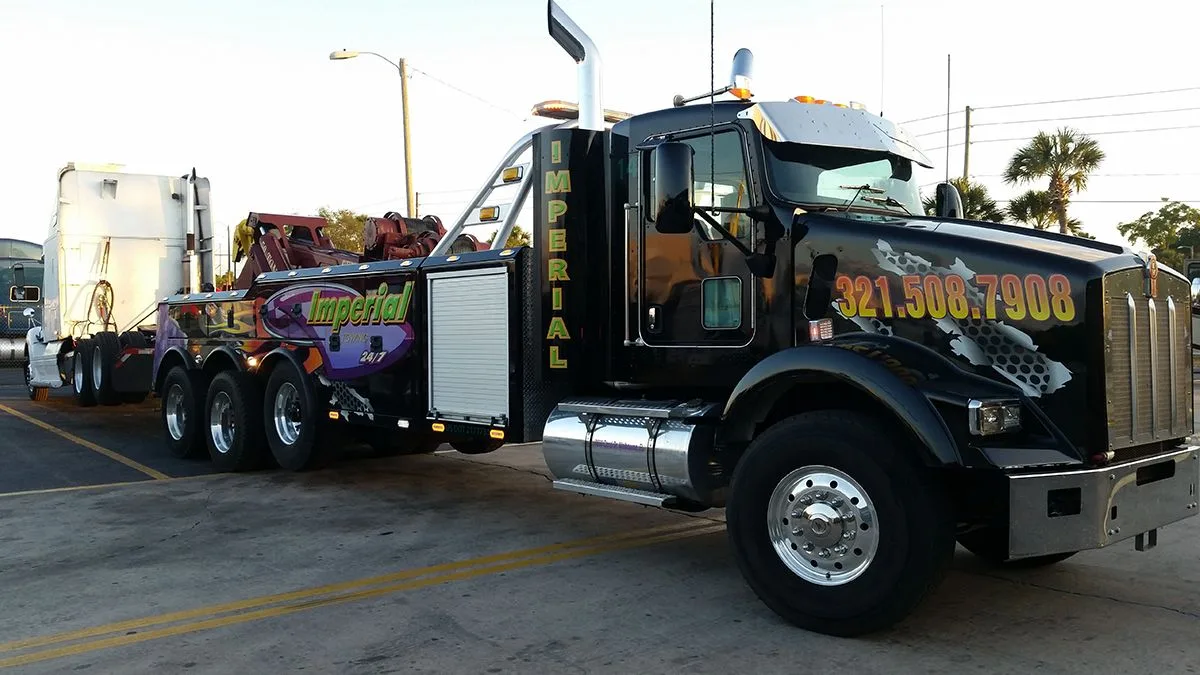
Distance, and what it means for your routes
Melbourne is home base. Orlando sits around 71 miles up the road from it, and we say that plainly because a fleet manager planning around a breakdown needs a number that holds. A unit already off the road and parked somewhere safe is exactly the work that distance suits, and we will give you a real window for the spot.
If a driver is hurt, or the truck is sitting in a live lane, call 911 first and let the closest responder handle it. Once the scene is safe, we come for the heavy part: the tow, the recovery if the unit left the pavement, and the drop to your shop.
For routes, the useful thing is predictability. Knowing the unit is headed for your shop on a set plan lets you reassign the load, swap in a spare tractor and tell the customer something real. That is how routes get back on track, one day at a time.
Some fleets keep a spare tractor parked in Orange County for exactly this reason. If yours does, put its location in the account, and dispatch can plan the drop around where that spare is waiting, so the freight changes tractors with as little driving as possible.
Municipal, utility and carrier fleets
Fleets differ. A carrier running sleepers through Orange County cares about freight windows. A municipal fleet worries about garbage and dump trucks out of service and the routes that do not get run. A utility fleet has bucket trucks and service bodies full of equipment that cannot sit unattended on a shoulder.
The account notes those differences so dispatch does not have to guess. Which units carry tools that need to stay locked, which ones go to a specific shop, which ones should never be towed without a supervisor on the phone. That knowledge stays in the account even when the fleet manager is on vacation.
Our drivers are certified online and hands-on, and heavy units are their everyday work. The fleet towing we run for Orlando accounts covers the setup in more detail, and a single tractor that quits outside any account goes the same way through semi-truck towing.
Fleet account questions
Do we need an account to call you for a fleet unit?
No. Any carrier can call for a single tow, and we will handle it. An account simply removes the questions that slow that call down, such as who approves the work, how billing goes and where each unit type should be dropped. Fleets that run Orange County regularly usually find it worth setting up once, before the next unit goes down.
What information should a driver give when a unit breaks down?
The unit number, the truck type, the axle count, whether the trailer is loaded or empty and the exact location with direction of travel. If the account lists a default drop for that unit, dispatch will use it unless the driver says otherwise. A short card in each cab with this list saves time on a stressful call.
Can one account cover units outside Orange County?
Yes. The account covers the whole fleet, statewide, under one number. A unit that breaks down near Orlando and another that quits across the state are handled by the same dispatch, with the same billing setup and the same drop rules. Distance changes the timing of each job, so we will give you an honest window for each location.
Set it up before you need it
Running units through Orange County? Call (321) 499-4610 and ask about opening a fleet account, or send us your fleet details and we will reach out. The Orlando service area page covers the rest of the heavy work we run there.