

The trip out is the part worth thinking about
Anybody who runs a coach, a box truck, a motorhome or an equipment trailer already thinks about the trip in. Where the site is, where to turn, where to park. Almost nobody thinks about the trip back out under a hook, and that is the trip that matters if something goes wrong. Cocoa Beach sits on a barrier island. Everything arrives over water and everything leaves the same way, which means a breakdown here is a routing problem before it is ever a lifting problem. Twenty-eight years of Brevard County work has made that the first thing dispatch asks about on a heavy call.
Your rescue is bigger than you are
Here is the piece that catches people out. Whatever is needed to move your vehicle is heavier and longer than your vehicle by itself. A disabled unit that came in loaded is heavier going out, and the combination of wrecker plus casualty has to clear every turn between where you stopped and the mainland. A crossing your rig managed comfortably alone is a different calculation with a heavy unit hooked to it.
Which is why the useful question to ask yourself before you cross is not “can I make it in” but “what would it take to get me out.” Weight limits, posted clearances and the plain physical width of a crossing decide which unit can come for you, and a wrecker that cannot make the trip is worth nothing at all, however capable it is elsewhere. That arithmetic happens on the phone, in the first minute, and it happens faster when you can describe your combination accurately.
None of the calculation lands on you in the moment. Say what you are driving, how it stopped and roughly where it sits, and the routing becomes somebody else’s problem from there. But the operators who get moving again quickest are consistently the ones who could answer those three things in a sentence each.
What to know about your own vehicle before you need it
A short list, and it is genuinely short. Have these somewhere you can read them without digging.
- Your combination length. Not the tractor, not the trailer, the whole thing hooked together as it sits.
- Your loaded weight, or a number you can stand behind, plus what the load actually is.
- Your height. Coaches and box bodies vary more than people assume, and roof equipment adds to it.
- Whether you have air brakes, and whether the system will hold or has failed. It changes how you get moved.
- Whether your unit will roll and steer with the engine off, which is a different question from whether it starts.
That is five answers, all of which you can write on a card in your cab today and none of which you want to be working out on a shoulder while traffic builds behind you. For a machine on a trailer, add whether it can be driven off under its own power, because that single fact determines whether you need a winch or a walk.
Where the shoulder runs out
Beach roads were laid out for beach traffic. Sand or a seawall frequently starts where the asphalt stops, which means the standard advice about getting fully clear does not always have anywhere to send you. A large vehicle that stops in that spot occupies a lane it cannot be pushed out of, and length makes it worse: a coach parked at an angle can close a turn entirely, and a trailer that folds takes up considerably more room than the two things it is made of.
So on a heavy call here, the closure is planned before the hook. The wrecker gets positioned to shield the work rather than add to the obstruction, whoever is managing traffic gets coordinated with, and the aim is to open the road once and keep it open. On a corridor without a second route, a recovery that drags becomes everybody’s afternoon, so a few extra minutes staging correctly buys the whole lift inside a single closure.
What you can do while waiting is mostly about information. Tell dispatch what is behind you, what is in front of you, and whether there is anywhere at all a truck could sit. Those three answers shape the setup before anybody arrives.
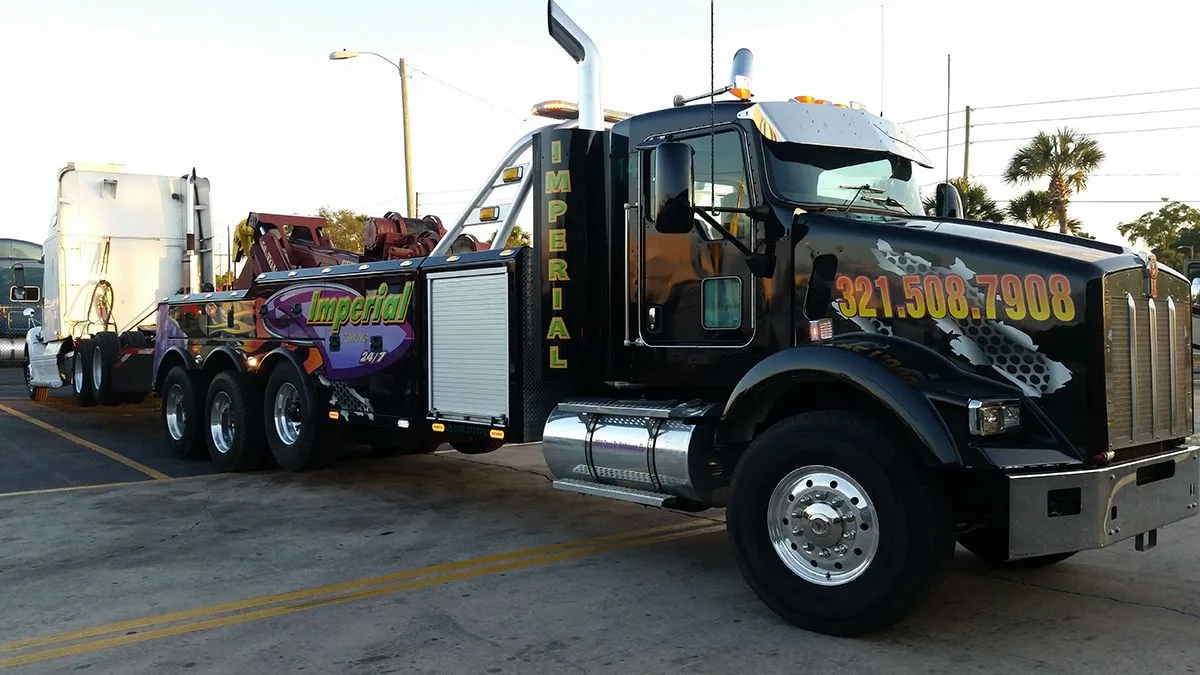
Why the right unit the first time is the whole game
The most expensive heavy job is the one attempted twice. A unit that shows up undersized, tries, and has to call for something larger has burned an hour of closed lane and left the caller exactly where they started with less daylight. Worse, an operator working past the rating of the truck under him can drop a load, and a dropped load on a narrow road is a much larger incident than whatever started the day.
The fleet here covers the range on purpose: cars and SUVs at one end, work vans and motorcycles in the middle, semis, buses, RVs and heavy equipment at the other. That breadth only pays off if the dispatcher sends correctly, which is why the questions on a heavy call are more detailed than on a light one. Certified operators on a well-kept fleet is the other half of it, because a truck that is ready leaves immediately and a truck that needs attention first costs you the entire delay before it reaches the road.
Cost gets settled at the same time as everything else. You hear a straight, no-surprise price on your tow before a unit leaves the yard, based on the vehicle and the distance, so nothing arrives later that was not said at the start. Commercial operators tend to notice that first and remember it longest, which is a fair part of why so much of the work here is repeat business.
Questions from people who run big vehicles
Should I call before I have a problem?
If you are bringing something large onto the island regularly, yes, and it costs nothing. A two minute conversation about what you run and where you take it means the details are already known when a real call comes. Plenty of commercial operators do exactly this and it turns their emergency into a shorter phone call.
What if I am not sure of my own weight?
Describe it instead. Number of axles, whether you are loaded, what you are carrying, roughly how long the whole combination is. That gets a dispatcher who has handled Brevard County heavy work for years close enough to send correctly. An honest description is worth more than a number you half remember from a document.
Does a breakdown on the island cost me more time than one inland?
It can, because the approach is fixed and traffic has nowhere to spread out. That is exactly why local knowledge matters here. Our operators cover these roads every week and know which way to come at a blocked stretch, which shaves genuine minutes off arrival and prevents the wrong-way trip that costs an hour.
Before the next crossing
Write your numbers on a card. Know whether your unit rolls with the engine off. Have a number saved that answers at three in the morning as readily as at three in the afternoon. Something large stopped on the island, or want Imperial saved before it happens? Call (321) 499-4610 or read the detail on heavy-duty towing in Cocoa Beach. If a lane is blocked right now, emergency towing is the faster route, and collision work runs through accident and collision recovery. You can also send us the details.